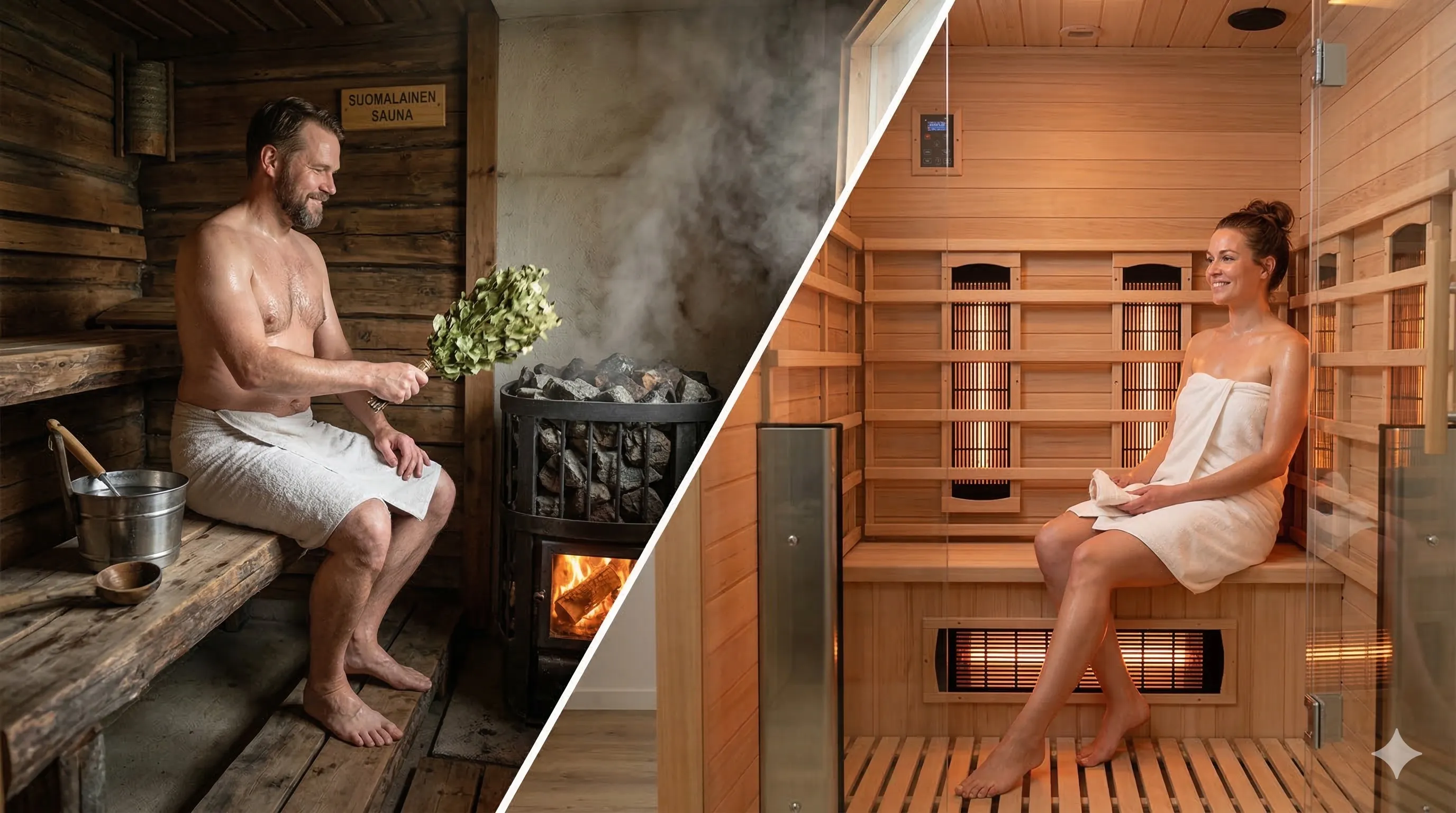
Traditional Sauna vs Infrared Sauna - What Actually Matters
The traditional sauna vs infrared sauna debate generates a lot of heat - mostly from sauna retailers with product to move. Here is what matters: these are fundamentally different heating methods that produce overlapping but distinct physiological responses. Neither is universally “better.” The right choice depends on your goals, your health status, and sometimes your living situation. This guide breaks down the evidence, gives you specific session parameters for each type, and shows you how to combine both modalities if you have access.
How Traditional and Infrared Saunas Actually Heat You
Convective Heat - How Traditional Saunas Work
A traditional sauna heats the air in the room using an electric heater, wood-burning stove, or gas heater loaded with stones. The room reaches 80-100°C (176-212°F), and your body absorbs heat primarily through convection - hot air transferring energy to your skin. Adding water to the stones creates löyly (steam), which spikes the humidity and dramatically increases the perceived heat intensity.
This is a high-thermal-stress environment. Your skin temperature climbs rapidly, your heart rate can reach 100-150 BPM (comparable to moderate exercise), and your core temperature rises 1-2°C over a 15-20 minute session. The cardiovascular demand is significant - your body is working hard to cool itself.
Radiant Heat - How Infrared Panels Work
Infrared saunas use panels that emit electromagnetic radiation in the far-infrared spectrum (wavelengths between 3 and 100 micrometers). Instead of heating the air around you, these panels heat your body directly through radiation - similar to how sunlight warms you on a cool day, but without UV exposure.
The cabin temperature stays much lower - typically 45-65°C (113-149°F) - because the air is not the primary heating medium. Your core temperature still rises, you still sweat, and your heart rate still increases, but the overall cardiovascular load is gentler. Some manufacturers offer “full-spectrum” panels that include near-infrared and mid-infrared wavelengths, though the clinical significance of these distinctions is not well established.
Both Heat You from the Outside In
A common marketing claim is that infrared saunas heat you “from the inside out” while traditional saunas heat “from the outside in.” This is a misconception. Research on far-infrared biological effects shows that FIR radiation is largely absorbed within the first few millimeters of skin - not transmitted deep into your core. The energy converts to heat at the skin surface, and that heat then conducts inward, raising core temperature gradually. Traditional saunas do the same thing through a different delivery method: hot air transfers energy to the skin via convection, and conduction carries it deeper.
The real difference is efficiency at a given air temperature. Infrared panels transfer energy directly to your skin via radiation, which is why you sweat meaningfully in a 55°C cabin that would feel mild in a traditional sauna. But the heating path - skin first, core second - is the same for both.
Both types raise core temperature, increase heart rate, and trigger the sweating response. Traditional saunas create a more demanding thermal environment that produces stronger cardiovascular and heat-acclimation responses per minute of exposure. Infrared saunas reach a meaningful thermal dose more slowly and with less overall cardiovascular stress - which can be either a limitation or an advantage, depending on who is using them.
What Does the Research Actually Say?
The Traditional Sauna Evidence Base
Traditional Finnish saunas have an enviable research portfolio. The KUOPIO Ischaemic Heart Disease Risk Factor Study followed over 2,300 Finnish men for 20+ years and found a clear dose-response relationship: men who used a sauna 4-7 times per week had a 40% lower risk of all-cause mortality compared to those who bathed once per week. A 2024 comprehensive review confirmed these findings and expanded the evidence base to include benefits for blood pressure, arterial compliance, and inflammatory markers.
This is strong, longitudinal, population-level data. It is also exclusively from traditional Finnish saunas at conventional temperatures (80°C and above). You cannot assume infrared saunas produce identical outcomes just because both “make you sweat.”
The Infrared Evidence Base
Infrared sauna research is smaller in scale but growing. Beever (2009) summarized far-infrared evidence showing improvements in endothelial function, blood pressure, and congestive heart failure symptoms. A 2021 crossover trial found that infrared sauna sessions mimicked some exercise-like cardiovascular responses in healthy women. And Mero et al. (2015) documented faster neuromuscular recovery when far-infrared sauna was used after strength and endurance training.
These are promising results, but the studies are smaller, shorter-term, and use varied protocols - making it harder to draw the kind of confident conclusions the Finnish cohort data supports.
Why Head-to-Head Comparisons Barely Exist
The 2018 systematic review by Hussain and Cohen - the most comprehensive review covering both sauna types - analyzed 40 studies and concluded that no meaningful comparative conclusions could be drawn. The studies used different populations, different protocols, different outcome measures, and different follow-up periods. Comparing Finnish cohort data on cardiovascular mortality with small infrared trials on chronic pain is not an apples-to-apples exercise.
This is the honest gap: we know traditional saunas are good for cardiovascular health. We know infrared saunas show promise for pain, recovery, and gentler cardiovascular stimulation. We do not have good data telling us whether one produces better outcomes than the other for any specific goal.
When Traditional Sauna Is the Better Choice
Cardiovascular conditioning. If your primary goal is cardiovascular health, traditional saunas have the stronger evidence base - by a wide margin. The dose-response data from Finland specifically links higher temperatures and more frequent sessions to reduced cardiovascular mortality. Passive heat therapy research supports the idea that the cardiovascular demand itself is what drives the benefit, and traditional saunas create more of it.
Heat acclimation. If you are preparing for endurance events in hot conditions or building general heat tolerance, you need meaningful thermal stress. Traditional saunas at 80°C+ deliver this more efficiently than infrared sessions at 55°C. Our beginner thermal exposure protocol covers how to build up progressively.
Social and cultural experience. The löyly ritual, bench-level hierarchy, cold plunge cycles, and communal bathing are central to Finnish and Russian sauna traditions. If the cultural dimension matters to you, traditional is the only option. Infrared saunas are typically solo experiences.
Session parameters for traditional sauna:
- Temperature: 80-95°C (176-203°F)
- Duration: 15-20 minutes per round
- Rounds: 2-3, with cool-down between each
- Hydration: 500ml water before, 250ml between rounds
- Cool-down: 2-5 minutes in cool air or a cold plunge
When Infrared Sauna Is the Better Choice
Chronic pain and musculoskeletal conditions. Despite marketing claims of deep tissue penetration, far-infrared is mostly absorbed at the skin surface. However, clinical trials still show meaningful pain relief for conditions like fibromyalgia, rheumatoid arthritis, and chronic low-back pain. The mechanism likely involves sustained mild hyperthermia - infrared’s lower intensity allows longer sessions (30-45 minutes vs 15-20), which means more total time at elevated tissue temperature. The therapeutic effect is real even if the “deep penetration” explanation is not quite right.
Heat-sensitive populations. Older adults, people with mild cardiovascular conditions (with physician clearance), and those who simply cannot tolerate the intensity of a traditional sauna may find infrared sessions accessible. The lower ambient temperature means less cardiovascular stress per session, which is sometimes exactly what is needed.
Home installation with constraints. Infrared saunas run on standard household electrical circuits (120V or 240V), require no special ventilation, and fit in a spare room corner. Traditional saunas need dedicated circuits, adequate ventilation, and heat-resistant construction. For many homes, infrared is the only feasible option.
Recovery-focused sessions. If you are using thermal exposure primarily for post-exercise recovery rather than cardiovascular conditioning, the evidence from Mero et al. suggests infrared may offer faster neuromuscular recovery with less additional stress on an already fatigued system.
Session parameters for infrared sauna:
- Temperature: 50-60°C (122-140°F)
- Duration: 30-45 minutes
- Panel proximity: sit within 15-20 cm of panels for maximum absorption
- Hydration: 500ml water before, sip during session
- Note: sauna hats are unnecessary in infrared - head overheating is not the limiting factor
Choosing by Goal - A Decision Framework
| Goal | Recommended Type | Why | Session Dose |
|---|---|---|---|
| Cardiovascular health | Traditional | Strongest evidence (KUOPIO cohort) | 15-20 min at 80°C+, 4-7x/week |
| Pain management | Infrared | Sustained mild hyperthermia, gentler load | 30-45 min at 55°C, 3-5x/week |
| Post-exercise recovery | Either (slight edge to infrared) | Infrared adds less stress to fatigued system | 20-30 min within 2 hours of training |
| Heat acclimation | Traditional | Higher thermal stress per minute | 15 min at 85°C+, daily for 7-14 days |
| Relaxation and stress | Either | Both trigger parasympathetic rebound | Personal preference on intensity |
| Sleep improvement | Either | Core temp drop post-session aids sleep | 15-20 min, finishing 1-2 hours before bed |
How to Combine Both Sauna Modalities
If you have access to both types - at a wellness center, gym, or through a home setup - combining them can address multiple goals that a single type cannot serve alone.
Alternating-Day Protocols
The simplest approach: use each type on different days based on your training and recovery schedule.
Example weekly schedule:
- Monday: Traditional sauna, 15 min at 85°C (post-strength training day, cardiovascular conditioning)
- Tuesday: Rest
- Wednesday: Infrared sauna, 35 min at 55°C (recovery day, pain management)
- Thursday: Traditional sauna, 15 min at 85°C
- Friday: Rest
- Saturday: Infrared sauna, 40 min at 55°C (relaxation, recovery)
- Sunday: Rest or light contrast therapy session
Same-Session Sequencing
Some facilities offer both types, and hybrid sauna units can run both simultaneously or sequentially.
Infrared-first sequence: Start with 20-25 minutes of infrared to warm your body gradually, then move to a traditional sauna for 10-15 minutes at 80-85°C. This approach gives you a longer warm-up phase and a shorter, more tolerable traditional session - good for people who find jumping straight into 85°C challenging.
Traditional-first sequence: Start with a standard 15-minute traditional session, then move to 20-30 minutes of infrared for extended low-intensity heating. This works well as a recovery protocol where you want both the cardiovascular hit and a longer sustained thermal dose without the intensity of a second traditional round.
Hybrid Sauna Units
Hybrid saunas combine a traditional convection heater with infrared panels in a single cabin. They let you run either mode independently or combine both simultaneously. The idea is appealing, but there are trade-offs: hybrid units often compromise on both the maximum traditional temperature and the infrared panel coverage to fit everything into one cabin. If your primary interest is one type, a dedicated unit will outperform a hybrid at that specific function.
That said, for home users who want versatility and have space for only one unit, a hybrid is a practical compromise.
Combining with Cold Exposure
Both sauna types pair well with cold exposure for contrast therapy. Traditional saunas produce a more dramatic temperature differential - going from 85°C to a 5°C cold plunge is a 80-degree swing that drives a powerful vascular pump effect. Infrared-to-cold transitions are gentler and may suit people who find full contrast therapy too intense.
Cost, Space, and Practical Considerations
| Factor | Traditional Sauna | Infrared Sauna |
|---|---|---|
| Home purchase cost | $3,000-$10,000+ | $1,500-$5,000 |
| Electrical needs | Dedicated 240V circuit (30-60 amp) | Standard 120V or 240V outlet |
| Ventilation | Required (dedicated vent) | Not required |
| Heat-up time | 30-60 minutes | 15-20 minutes |
| Running cost per session | $1-3 (higher wattage) | $0.30-$1 (lower wattage) |
| Expected lifespan | 15-25 years | 8-15 years |
| Public availability | Gyms, spas, dedicated sauna centers | Less common, growing in wellness studios |
For public access, traditional saunas remain far more widely available. Most commercial gyms with a sauna have traditional units. Infrared saunas are more common in dedicated wellness studios and boutique recovery centers. If you are tracking sessions and building a consistent protocol - see our HRV sauna setup guide for how to measure your response - home access to either type makes a meaningful difference in adherence.
Safety Considerations by Sauna Type
Shared contraindications for both types: Pregnancy, uncontrolled hypertension, acute illness or fever, open wounds, recent alcohol consumption, and certain medications (particularly those affecting blood pressure or thermoregulation). If you have any cardiovascular condition, get clearance from a cardiologist before using either sauna type.
Traditional sauna - specific risks:
- Higher dehydration risk due to extreme temperatures. Drink water before, between rounds, and after.
- Greater cardiovascular demand - heart rate can reach 150 BPM. People with borderline cardiovascular fitness should start with shorter sessions at lower bench positions.
- Steam (löyly) significantly increases perceived heat. New users should avoid adding water to stones until they are comfortable with dry heat.
Infrared sauna - specific risks:
- EMF exposure varies dramatically by manufacturer and panel quality. Low-EMF certification matters. See our EMF testing guide for how to evaluate units.
- The lower perceived intensity can lead to overlong sessions. Set a timer and respect it, especially while building tolerance.
- “Detox” marketing claims around infrared saunas are largely unsupported. Sweating eliminates small amounts of heavy metals and BPA, but the clinical significance of this versus normal kidney and liver detoxification is not established.
Frequently Asked Questions
Is Infrared “Better” Than a Traditional Sauna?
No. They are different tools for different goals. Traditional saunas have stronger cardiovascular evidence. Infrared saunas are gentler, more accessible for heat-sensitive people, and show promise for pain management. Asking which is better is like asking whether a barbell or resistance band is better - it depends entirely on what you are training for.
Can You Get the Same Cardiovascular Benefits from Infrared?
Unclear. The cardiovascular mortality data comes almost entirely from studies on traditional Finnish saunas at 80°C and above. Infrared saunas do raise heart rate and improve endothelial function, but no long-term outcome studies at the scale of the KUOPIO cohort exist for infrared. Evidence suggests cardiovascular benefits from infrared exposure, but we cannot claim equivalence with traditional sauna.
How Long Should Each Session Be?
Traditional: 15-20 minutes per round at 80-95°C, with 2-3 rounds separated by cool-down. Infrared: 30-45 minutes in a single continuous session at 50-60°C. Both types should be limited to what feels sustainable - if you need to leave, leave.
Can You Use Both Types in the Same Day?
Yes, but be mindful of total thermal dose. If you do a full traditional session in the morning and an infrared session in the evening, ensure you are well-hydrated and that neither session is at maximum intensity. For most people who are sauna-adapted, same-day use is fine. If you are new to thermal exposure, build tolerance with one type at a time first.
Do Infrared Saunas Really “Detox” Better?
This is a marketing claim that outpaces the evidence. Sweat does contain trace amounts of heavy metals and organic compounds, and infrared saunas produce sustained sweating at lower temperatures. But the amounts eliminated through sweat are small compared to what your kidneys and liver process daily. Use infrared saunas for pain relief, recovery, and gentle cardiovascular stimulation - not as a primary detoxification strategy.
Choosing between a traditional sauna and an infrared sauna does not need to be an either-or decision. Understand what each type does well, match it to your goals, and if you can access both, use them for what they are each best at. For a complete thermal practice, consider how either type fits into a broader stack that includes cold exposure, contrast therapy, and recovery tracking.
If you are brand new to thermal exposure, start with our beginner protocol before layering in multiple modalities. If you are already sauna-adapted and want to measure your body’s response to different sauna types, our HRV tracking setup guide will help you see the difference in the data.