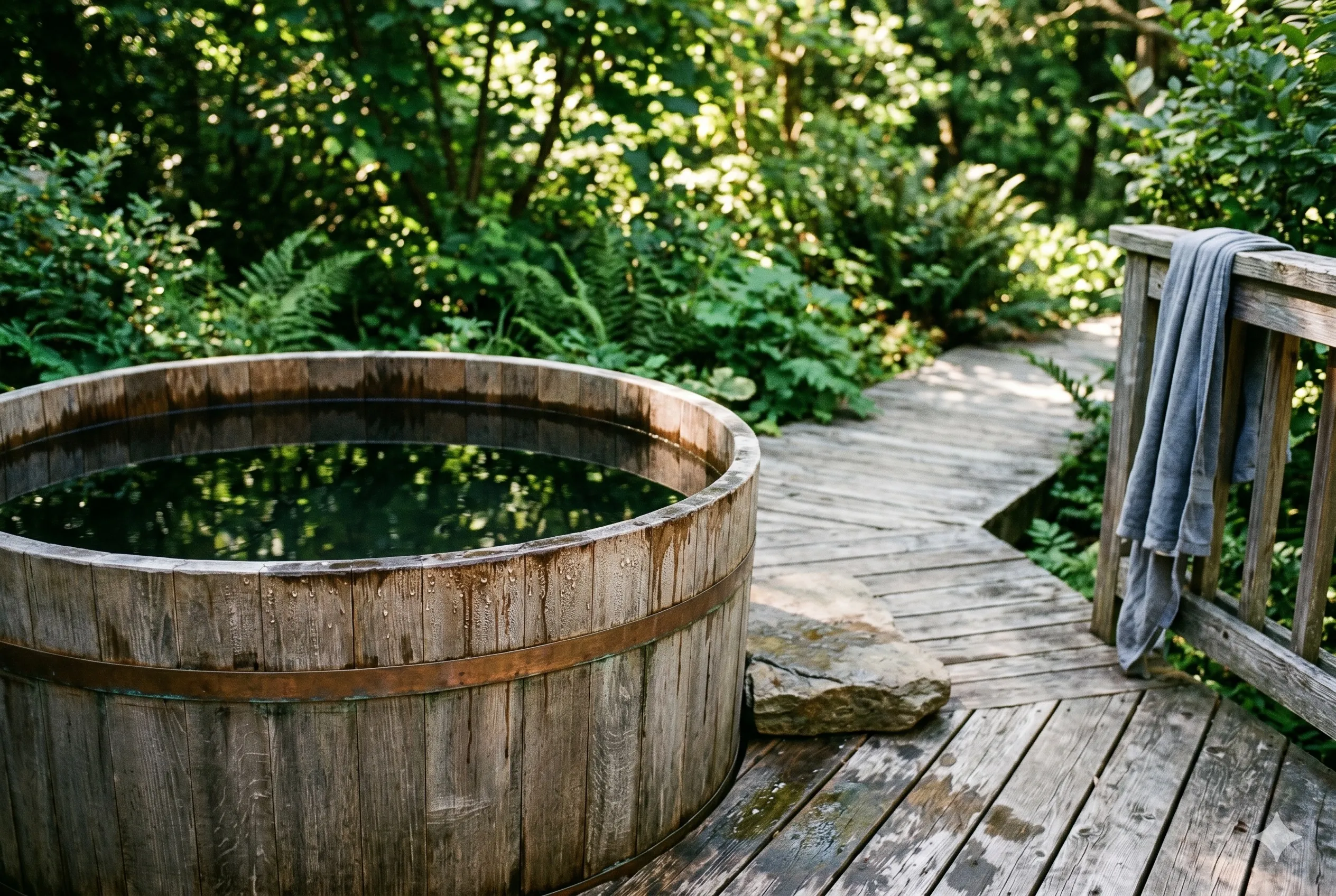
You built the habit over winter. The plunge felt brutal in a satisfying way - a sharp, gasping shock that left you wired and clearheaded for hours. Then summer arrived, the tub warmed up, and stepping in no longer felt like an ordeal. Now you are wondering whether you are still getting anything out of it, or just taking a cool bath.
The short answer is: yes, cold plunging in summer is still worth it. But the reasons shift with the season, and one practical variable - your water temperature - matters more in summer than at any other time of year.
What Actually Happens When You Cold Plunge
Before diving into the seasonal question, it helps to be clear on the baseline physiology.
When your skin contacts cold water, your body triggers a cascade of responses. The cold shock response kicks in within the first few seconds: gasping, a spike in heart rate, and rapid breathing as your nervous system registers the sudden temperature change. Simultaneously, norepinephrine surges - research documents increases up to 300% above baseline in controlled cold immersion studies, with some protocols at 14°C (57°F) over 60 minutes showing responses as high as 530%. In real-world plunges of 2-5 minutes at typical consumer temperatures (10-15°C / 50-59°F), the acute response is smaller, but still significant. Research on cold water immersion and neurohormonal responses documents the dopamine and norepinephrine effects with clinical precision.
Evidence suggests dopamine also rises substantially post-plunge - around 250% above baseline in some studies, though the primary sources for this specific figure are not always cited precisely. The better framing: the mood and brain network effects of cold immersion are well-documented, even if the exact magnitude varies across studies and protocols.
Does the Temperature Difference Still Matter When It Is Hot Outside?
This is the core question, and the answer is genuinely interesting.
The cold shock response is driven primarily by the rate of skin temperature drop - not the absolute water temperature. In summer, your skin surface temperature is higher (roughly 32-35°C / 90-95°F compared to 28-31°C / 82-88°F in winter). When you step into a 10-13°C (50-55°F) plunge, the temperature differential is actually larger in summer than in winter. This means the initial cold shock response may be more pronounced in warm weather, not less.
That said, there is an important nuance for newer plungers: if you built your habit through winter and habituated to the shock, research by Tipton et al. shows that habituation of the cold shock response persists for 7-14 months. If you habituated last winter, you still have that buffer. But someone starting fresh in summer faces the same acute shock response as any beginner - warm ambient temperature does not dampen it. Start conservatively.
There is one honest evidence gap worth flagging: no direct randomised controlled trial has compared the norepinephrine response to a fixed-temperature plunge under summer versus winter ambient conditions. Mechanistically, if your water stays at 10-15°C, the stimulus should be comparable year-round. But this is an inference from physiology, not a direct summer-vs-winter RCT.
The practical implication: your plunge works the same in summer, as long as the water stays cold. That is the variable that changes.
Three Ways Cold Plunging Actually Works in Your Favour in Summer
Pre-Cooling Before Exercise in the Heat
This is the strongest evidence-based summer use case for cold immersion - stronger than in any other season.
Pre-cooling before exercise in hot conditions is well-supported. A meta-analysis by Bongers et al. (2020) published in IJERPH found that pre-cooling improved distance covered by 1.5-13.1% and time to exhaustion by 19-31.9% in hot conditions. A 2024 systematic review and meta-analysis in MDPI Nutrients added further support for the approach.
The mechanism: cold immersion before exercise lowers skin and core temperature, creating a larger thermal buffer - more headroom before your core hits the roughly 39.5°C (103°F) critical threshold where performance deteriorates and heat illness risk rises.
Practical parameters based on the research: 10-15 minutes in 10-15°C (50-59°F) water, finishing 5-10 minutes before exercise begins. This timing allows the vasoconstriction to begin resolving and avoids starting your session with cold, stiff muscles.
One important caveat: the evidence is strongest when ambient temperature is at or above 30°C (86°F). Below 24°C (75°F), the ergogenic benefit is less clear, as noted by Daanen et al. (2015). The 24-30°C range is a genuine evidence gap - the benefit likely exists but is less pronounced.
Evening Plunge for Sleep on Hot Nights
Sleep requires your core body temperature to drop 1-2°F in the evening - this is a well-established part of the sleep initiation process. On hot nights, when your bedroom stays above 18°C (65°F), that cooling process is impaired, and sleep quality measurably suffers. Large observational datasets consistently show this association.
A cold plunge 60-90 minutes before bed can accelerate core temperature drop, making it easier to fall asleep. A modest session in 15-18°C (59-64°F) water for 3-5 minutes targets this goal without excessive sympathetic activation.
The 60-90 minute gap is important. Immediately post-plunge, the cold shock drives sympathetic nervous system activation - elevated heart rate, heightened alertness. Plunging right before bed and expecting to fall asleep immediately is asking the physiology to do two contradictory things at once. Give yourself the buffer.
One hedge worth being explicit about: the strongest sleep and temperature research involves warm bath immersion, not cold. Haghayegh et al. (2019) demonstrated that a warm bath 1-2 hours before bed raised peripheral blood flow and accelerated passive heat dissipation, improving sleep onset. Cold plunging works by a different mechanism - direct core temperature reduction - and lacks the same volume of direct RCT evidence for sleep improvement. The reasoning is mechanistically sound; the direct data for cold-plunge-as-sleep-aid is thinner. Treat it as a reasonable experiment, not a proven protocol.
Mood, Focus, and Mental Reset - Unchanged Year-Round
The norepinephrine and dopamine response to cold immersion is tied to water temperature contact, not the season or ambient air temperature. If your tub is cold, the mechanism is intact.
The Søberg et al. protocol - roughly 11 minutes per week across 2-3 sessions - documented metabolic and thermoregulatory adaptations in healthy participants. It is worth being precise here: this specific protocol was designed to study brown adipose tissue activation and metabolic changes. The 11-minute figure should not be generalized as a minimum effective dose for mood, performance, or sleep benefits - those outcomes follow different dose-response curves.
That said, the acute mood and focus benefit from any given plunge is among the most consistent practitioner-reported outcomes, and the catecholamine evidence supports it. In summer, when heat causes cognitive sluggishness and disrupted mood, a mid-day cold plunge delivers a reliable reset. The same physiology applies equally in July and January.
The One Variable That Actually Changes in Summer: Water Temperature
An outdoor stock tank in direct sun can climb from 10°C (50°F) to 18°C (64°F) in a few hours on a hot day. At 18°C, you will still feel the water as refreshing - but the physiological stimulus is attenuated. The cold shock response, the norepinephrine spike, the acute dopamine elevation - these scale with the temperature differential. A 22°C (72°F) tub is a cool bath, not a cold plunge.
The dose in cold immersion is temperature x time x immersion depth. In summer, maintaining temperature is the primary challenge.
Practical options in order of reliability:
- A dedicated chiller unit provides the most consistent temperature control with minimal effort
- Large quantities of ice work but add up in cost and logistics over a full summer
- Pre-cooling tactics - shade, insulating covers, filling with cold tap water immediately before plunging - can help but are less reliable in sustained heat
A simple rule of thumb: if you can step in without gasping, the water is probably above 15°C and the full physiological stimulus is not present. Use a thermometer to track temperature objectively - feel is not reliable here.
A Practical Summer Protocol
Three session types, matched to goal:
Pre-workout (active in heat above 27°C / 80°F): 10-15°C (50-59°F) water for 10-15 minutes, finishing 5-10 minutes before exercise. This is where summer cold exposure has its strongest evidence base.
Evening reset for sleep: 15-18°C (59-64°F) water for 3-5 minutes, 60-90 minutes before bed. Do not go colder here - you want temperature drop without the full sympathetic activation spike that would oppose sleep.
Midday mental reset: 10-15°C (50-59°F) water for 2-5 minutes. Standard protocol. The same session you would do any other time of year, with the same expected effects.
A note for beginners: Summer is actually a gentler entry point than winter for starting cold exposure. The warmer pre-plunge ambient temperature means the cardiovascular shock is slightly less abrupt than plunging from a cold room. The cold shock response is still real - start with shorter durations and never plunge alone.
What Changes, What Does Not
| Use Case | Evidence Strength | Summer vs. Year-Round |
|---|---|---|
| Pre-cooling for athletic performance in heat | Strong (multiple meta-analyses) | Summer-specific benefit |
| Norepinephrine / dopamine mood-focus spike | Strong | Year-round, unchanged |
| Sleep aid on hot nights | Mechanistically plausible, limited RCT | Summer-amplified usefulness |
| Cold shock habituation maintenance | Strong | Requires maintaining water temp |
| Recovery / muscle soreness reduction | Moderate | Year-round, unchanged |
Frequently Asked Questions
Is summer a good time to start cold plunging?
Yes - the pre-plunge ambient environment is warmer, which many beginners find less intimidating, and the skin temperature differential to a cold tub is still sufficient to produce the cold shock response. The main caveat: do not mistake warm tub water for cold plunging. Track temperature and keep it below 15°C (59°F).
My tub feels warmer in summer - should I add ice?
If your water is above 15°C (59°F), the neurochemical stimulus is attenuated. Add ice or invest in a chiller, and verify with a thermometer. Feel is not reliable for gauging water temperature accurately.
Can I plunge right before bed to sleep better on a hot night?
Not immediately before - the acute sympathetic activation (elevated heart rate, heightened alertness) takes time to resolve. Give yourself 60-90 minutes between plunge and bedtime. The physiology works in your favour when timed correctly.
Does the benefit decrease because my body is already warm in summer?
No - the physiological stimulus comes from the skin-to-water temperature drop rate, which is actually larger in summer because your starting skin temperature is higher. The benefit requires the water to be genuinely cold; it does not require the air to be cold.
If you are building a contrast therapy practice that combines heat and cold, the contrast therapy complete guide covers how to sequence both modalities effectively. For context on how the heat side of summer thermal exposure works, sauna in summer heat is a natural companion to this piece.
New to cold exposure entirely? The beginner thermal exposure protocol covers the foundation before adding cold sessions.