Two Steam Rooms, Two Worldviews
The Finnish sauna vs Russian banya comparison usually stops at a temperature chart and a paragraph about birch whisks. That misses the point entirely. These are not just two ways to get hot - they are two fundamentally different philosophies of what heat is for, how community works, and what counts as wellness.
One tradition prizes silence and solitude. The other builds its entire practice around noise, contact, and communal care. Understanding the difference changes how you approach thermal exposure, regardless of which tradition you prefer.
A Thousand Years of Steam
The Finnish Sauna - From Smoke Pits to UNESCO
The Finnish sauna tradition stretches back at least 2,000 years, beginning as earth-pit fires covered with animal skins. The earliest permanent saunas were savusaunas - smoke saunas without a chimney, where birch wood was burned for hours before bathing in the residual heat. These structures served as more than bathhouses. Finnish women gave birth in them. The sick were treated in them. The dead were washed for burial in them.
That depth of integration explains why sauna is not a hobby in Finland - it is infrastructure. There are roughly 3.3 million saunas for 5.5 million people. Nearly 90% of the population uses one weekly. In December 2020, UNESCO inscribed Finnish sauna culture on its Representative List of Intangible Cultural Heritage - Finland’s first inscription on that list.
The Russian Banya - Fire, Water, and Steam
The banya’s documented history begins in the 12th century, when the monk Nestor described early Slavic steam bathing in his chronicles. But the practice almost certainly predates the written record. Built on the harmony of three elements - fire, water, and steam - the banya became embedded in Russian Orthodox and folk rituals. Weddings were preceded by communal banya sessions. Newborns were bathed in them. The sick were treated with steam and herbal whisks.
As historian Ethan Pollock documents in Without the Banya We Would Perish (Oxford University Press, 2019) - the first English-language history of the institution - the banya has survived the Mongols, Peter the Great, and Soviet communism. For over a thousand years, Russians across every economic class have treated bathing as a communal activity that integrates hygiene with ritual, relaxation, political intrigue, and social bonding.
What the Books Tell Us
The scholarly literature on these traditions reveals how each culture understands its own bathing practice. Pollock’s banya history frames the bathhouse as a pillar of Russian national identity - a space where social hierarchy dissolves and community coheres.
On the Finnish side, Mikkel Aaland’s Sweat (1978, updated 2012) places the sauna within a global comparative framework alongside the banya, the hammam, and the temescal. Where the banya literature emphasizes social function, Finnish sauna scholarship tends to emphasize the personal and the spiritual - the relationship between the individual bather and the heat itself.
This difference in framing is not incidental. It reflects the core philosophical divide between the two traditions.
Inside the Heat - Finnish Sauna vs Russian Banya in Practice
Temperature, Humidity, and the Physics of Heat
The headline numbers: Finnish saunas typically run at 80-100°C (176-212°F) with low humidity of 10-20%. Russian banyas operate at a lower 60-80°C with much higher humidity of 40-60%.
Those numbers can be misleading. Wet heat transfers energy to the body far more efficiently than dry heat. A banya at 70°C with 50% humidity can feel significantly more intense than a Finnish sauna at 85°C with 10% humidity. The experience of heat is not just about the thermometer reading - it is about how fast thermal energy moves into your skin.
The Finnish stove (kiuas) heats rocks that radiate dry warmth, punctuated by löyly - the burst of steam when water hits the stones. Löyly is an accent, not the baseline. In the banya, sustained steam is the medium itself. The parilka (steam room) is designed to hold moisture, and the banshchik (bath attendant) manages steam levels throughout the session.
The Ritual Toolkit
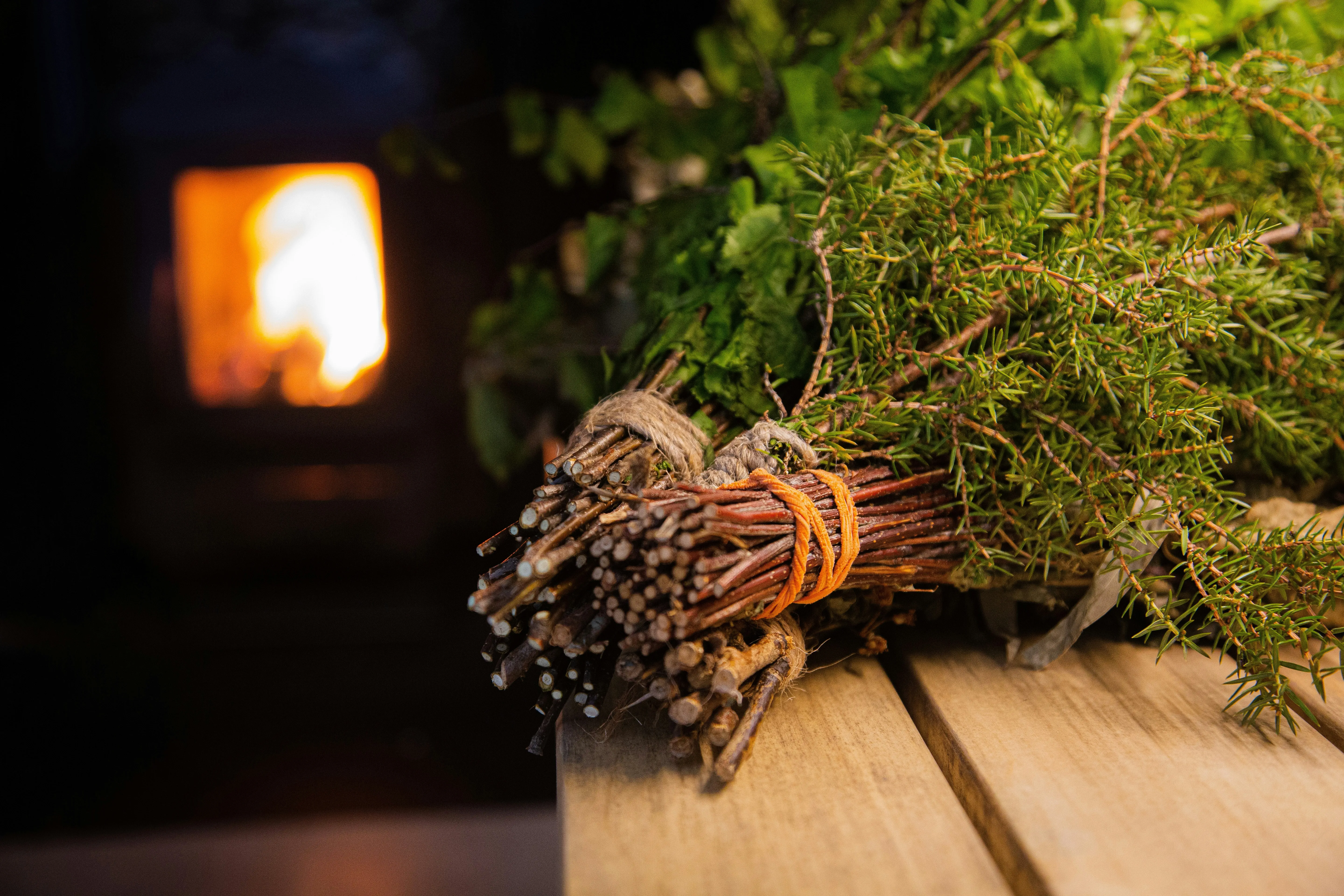
Here the traditions diverge sharply. Finnish sauna culture is built around löyly and quietude. Some bathers use a vihta (or vasta, depending on region) - a bundle of fresh birch branches used for gentle self-massage. But vihta use is occasional, regional, and secondary to the heat experience itself. The core Finnish practice is sitting, sweating, and being present. Phones, music, and scented oils have nothing to do with traditional Finnish sauna.
The Russian banya, by contrast, is incomplete without the venik - a whisk made from birch, oak, eucalyptus, or linden branches, harvested during midsummer and carefully dried to preserve their essential oils. The platza ritual involves soaking the venik in hot water and using it to drive steam onto the body in rhythmic, full-contact massage. This is not a gentle tap. It is vigorous, deliberate, and performed by another person - an act of communal care that is central to the banya experience.
If you have ever wondered why sauna hats are more common in Russian banya culture than Finnish - this is why. When someone is actively driving steam onto your body, head protection becomes practical, not decorative.
The Social Contract
In a Finnish sauna, silence is the default. There is a saying: “In the sauna, one must conduct oneself as one would in church.” Conversation happens, but softly. There are no titles in the sauna. You do not pour water on the stones without asking others first. And you do not throw löyly and then leave - if you raise the temperature, you stay to experience it.
The Russian banya runs on the opposite frequency. It is social by design - a place for storytelling, dispute resolution, toasting with friends, and informal business. The platza ritual itself requires another person, making isolation structurally impossible. Where the Finnish sauna offers retreat from the world, the banya is a compression of it.
Both traditions share some ground rules: public bathing is typically gender-separated, nudity is normative, and pre-bathing hygiene (showering before entering) is expected.
Finnish Sauna vs Russian Banya: What the Science Says
The Finnish Evidence Advantage
Here is where the comparison gets uneven - and interesting. Almost all longitudinal clinical research on sauna bathing is Finnish-specific. The landmark Kuopio Ischaemic Heart Disease Risk Factor Study (KIHD) followed over 2,000 Finnish men for 20+ years and found that frequent sauna bathing was associated with reduced cardiovascular mortality and lower all-cause mortality risk.
Systematic reviews reinforce the pattern. Hussain and Cohen’s 2018 review of 40 studies on dry sauna bathing found evidence suggesting benefits for cardiovascular function, pain conditions, and respiratory health. A 2024 comprehensive review in Temperature found that passive heat therapies - with Finnish sauna as the most-studied modality - show promise for extending healthspan across vascular and nonvascular domains.
The Mayo Clinic Proceedings review of Finnish sauna combined with lifestyle factors found additional health benefits when regular sauna bathing was paired with exercise and other healthy behaviors. Evidence suggests the relationship is dose-dependent - more frequent sessions correlate with better outcomes, though the research has limitations worth noting.
The Banya Research Gap
Russian banya-style wet-heat bathing lacks equivalent clinical data. There are no large prospective cohort studies tracking banya bathers over decades. The health claims associated with banya - improved circulation, respiratory benefits, immune support - rest primarily on centuries of folk tradition and mechanistic reasoning rather than controlled trials.
This gap is itself a story. It reflects which cultures invested in formalizing health research around their bathing traditions and which relied on oral tradition and lived experience. It does not mean the banya is less effective - it means we have less data. The core physiological mechanism is the same: passive heating raises core body temperature, triggering cardiovascular, hormonal, and inflammatory responses. Whether the heat arrives dry or wet may matter less than the total thermal dose delivered.
For a deeper look at what the Finnish research actually shows for specific populations, see our breakdown of sauna benefits for men.
Where in the World
The Finnish Sauna Goes Global
Finnish-style saunas held roughly 43% of the global sauna market share in 2023, making them the dominant tradition worldwide. The global sauna market itself was valued at $859.5 million that year and is projected to reach $1.27 billion by 2030.
The Finnish sauna has strong footholds outside Scandinavia: across Germany and Austria (where sauna culture runs deep), in the United States (particularly Minnesota, the Pacific Northwest, and urban wellness centers), and increasingly in Japan, where approximately 10 million people now use saunas regularly. UNESCO recognition in 2020 accelerated international awareness, and the “Sauna from Finland” certification program actively promotes authentic Finnish sauna standards worldwide.
The Banya Diaspora
Russian banya culture spread primarily through emigre communities rather than institutional marketing. New York’s bathhouse tradition dates to 1892, with establishments like the 10th Street Russian & Turkish Baths becoming neighborhood institutions. London’s Banya No.1 has built a modern brand around the traditional parenie ritual. Berlin, with its large Russian-speaking population, hosts several authentic banyas.
The banya’s footprint remains smaller than the Finnish sauna’s, but it is growing - partly because the contrast therapy trend has made hot-cold cycling fashionable, and the banya’s built-in cold plunge tradition suddenly looks prescient.
The Slavic banya tradition extends beyond Russia, too. Bulgaria’s mineral spring bathing culture shares roots with the Russian practice, adapted to the country’s extraordinary geothermal resources.
Modern Fusion
Today’s wellness facilities increasingly blend both traditions - dry rooms alongside steam rooms, cold plunges after both, venik rituals offered in Finnish-style spaces. Whether this fusion dilutes or democratizes is a matter of perspective. Purists in both traditions would argue that removing the cultural context strips the practice of its meaning. Pragmatists point out that more people experiencing quality thermal exposure is the goal, regardless of the label.
Choosing Your Heat
The right tradition for you depends on what you want from the experience:
- If you prefer dry, intense heat and quiet reflection: Finnish sauna
- If you want communal ritual and hands-on steam massage: Russian banya
- If you are new to thermal exposure: Start with our beginner protocol - it applies to both traditions
Both deliver effective thermal dose. Both have deep cultural roots worth respecting. The protocol parameters - temperature, duration, frequency, and recovery - matter more than which flag hangs outside the door. And as with any thermal exposure, if you have cardiovascular conditions or are pregnant, consult a healthcare provider before starting either tradition.
Frequently Asked Questions
Is a banya hotter than a Finnish sauna?
Not by thermometer reading. Finnish saunas typically run 80-100°C while banyas operate at 60-80°C. But the banya’s high humidity (40-60% vs 10-20%) means heat transfers to your body more efficiently, so a lower-temperature banya can feel more intense than a hotter Finnish sauna.
Can you use a venik in a Finnish sauna?
Finns have their own version - the vihta (or vasta) - but its use is gentler and less central than the Russian platza ritual. In a private Finnish sauna, using birch branches is common. In a public Finnish sauna, check with other bathers first, as the practice is less universal than in Russian banya culture.
Which tradition has more proven health benefits?
Finnish sauna has far more clinical research behind it, including the landmark KIHD cohort study tracking outcomes over 20+ years. Banya health claims rest primarily on traditional knowledge rather than controlled trials. Both traditions raise core body temperature through passive heating - the fundamental mechanism is shared, but the Finnish data is stronger.
Where can I try an authentic banya outside Russia?
Major cities with established banya culture include New York (10th Street Russian & Turkish Baths, Wall Street Bath & Spa), London (Banya No.1 in Chiswick and Hoxton), Berlin (several authentic banyas in neighborhoods with Russian-speaking communities), and Tel Aviv. Look for places that offer the full parenie/platza experience with trained banshchiks rather than just a generic steam room.